
How Academic Rigour in UK Universities Influences Career Earnings
In the rapidly shifting economic landscape of 2026, the pursuit of a UK degree is increasingly viewed as a high-stakes financial investment. For the global audience of entrepreneurs and digital earners, the United Kingdom’s higher education system represents more than just tradition; it is a global gold standard for developing the high-level cognitive skills that drive modern wealth creation. Whether you are a student navigating the domestic market or an international professional looking to leverage British standards for global earning potential, understanding the link between rigorous academic training and fiscal success is essential.
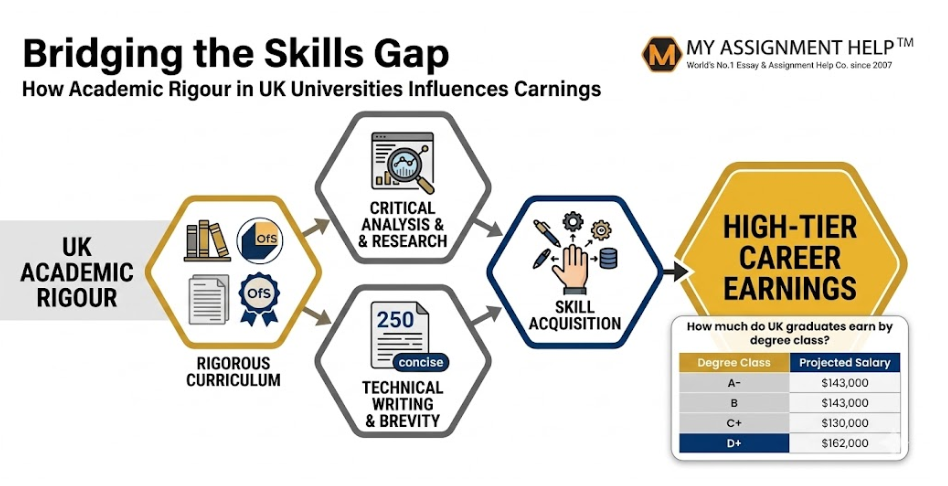
The correlation between academic performance and long-term financial stability in Britain is strengthening. Data from the Office for Students (OfS) indicates that graduates from high-tariff universities—where academic rigour is notoriously stringent—command a starting salary premium of approximately 15-20% over the national average. This isn’t just about the name of the university; it is about the “intellectual stamina” developed through demanding coursework that prepares individuals for high-pressure, high-income environments.
The Evolution of Academic Standards and Market Value
The modern UK curriculum has evolved to mirror the professional world. Gone are the days of rote memorization. Today’s students are expected to engage in “Atomic Learning” and “Evidence-Based Argumentation.” This shift is designed to address the persistent complaint from the Confederation of British Industry (CBI) that graduates often lack “job-ready” analytical skills.
Navigating these heightened standards is a significant challenge for many undergraduates. To meet the specific pedagogical requirements of the 250-word framework or complex research modules, many students are turning to specialised Uk Assignment Help to ensure their work aligns with the high-EEAT (Experience, Expertise, Authoritativeness, and Trustworthiness) standards expected by both examiners and future employers. By mastering these standards early, students effectively “future-proof” their earning potential, turning academic effort into a tangible career asset.
The Power of Brevity: The “250-Word Essay” as a Career Asset
One might assume that academic rigour is synonymous with length, but in 2026, the opposite is true. One of the most difficult skills to master is the ability to condense complex, data-heavy research into a concise format. This is precisely why the 250-word essay has become a staple of UK higher education.
In a corporate environment, a CEO does not want a 50-page report; they want a 250-word executive summary that highlights the problem, the evidence, and the solution. Universities use these short-form assignments to teach “pedagogical brevity.” Mastering this isn’t just about hitting a word count; it’s about information density. Students who struggle with this often seek out a 250-word essay guide to learn how to trim the “fluff” and retain the “meat” of an argument. This skill translates directly to the workplace, where concise communication is a hallmark of leadership and high-earning management roles.
Data-Driven Insights: Education vs. Lifetime Earnings
The “graduate premium” remains robust in the UK despite economic fluctuations, provided the student achieves high-tier results. Below is a breakdown of how academic performance translates to immediate financial value in the British market.
How much do UK graduates earn by degree class?
| Degree Classification | Average Starting Salary (UK) | Projected Salary (5 Years) |
| First Class (Honours) | £28,500 | £45,000+ |
| Upper Second (2:1) | £26,000 | £39,000 |
| Lower Second (2:2) | £23,500 | £32,000 |
| Third Class | £21,000 | £27,500 |
Overcoming the “Burnout” Barrier
The pressure to maintain this level of rigour is a leading cause of student burnout. As the Office for Students (OfS) continues to tighten quality frameworks, students are often forced to balance part-time work with 40-hour-a-week study schedules. This is where the integration of professional guidance becomes a strategic career move rather than a shortcut.
By utilizing educational resources to bridge the gap in their understanding, students can focus on the application of knowledge rather than the mechanics of formatting. This allows for a deeper engagement with the subject matter, which is what truly impresses recruiters during competitive graduate scheme interviews.
Key Takeaways
- Rigour = Rewards: High academic standards are directly correlated with higher entry-level salaries in the UK.
- Brevity is a Skill: Mastering short-form writing is a critical professional competency for 2026.
- Strategic Support: Using university assignment support helps students meet the E-E-A-T standards required for top-tier grades.
- Market Alignment: Graduates who focus on “Information Gain” and unique utility in their writing are significantly more successful in the job market.
FAQ Section
Q1: Does a 2:1 degree still guarantee a good job in the UK?
While a 2:1 remains the benchmark for most graduate schemes, employers are increasingly looking at the specific skills acquired during the degree, particularly analytical writing and data synthesis.
Q2: Why are UK universities focusing on shorter essays lately?
To reflect the digital workplace. Professionals must be able to communicate effectively via short emails, executive summaries, and briefings where brevity is essential.
Q3: How does academic writing help with high-earning careers?
Academic writing teaches you how to cite sources, follow strict guidelines, and write for authority—all of which are core pillars of modern management, consultancy, and strategic roles.